Stats and effects
For Add/Set/Link/Limit/Convert, Target is a stat id. The inspector offers the selected content's stat catalog; a valid id outside that catalog remains editable. List operations use free-form entry ids with a List key. A nonempty Handler selects a registered custom effect implementation.
| Method | Meaning |
|---|---|
| Add | Add Amount within the selected permanent/temporary fold |
| Set | Replace the preceding scalar fold in that layer |
| Tally | Accumulate a keyed value in a named list |
| Append | Append a key/value entry; duplicates are retained |
| AppendUnique | Keep an id while at least one provider remains |
| Link | Read Source, divide by Unit, multiply by Amount, then transform/round/clamp output |
| Convert | Explicitly consume a source budget and create output at a boundary |
| Limit | Set a fixed, captured or following minimum/maximum |
Evaluated methods require valid explicit values. In particular, Unit must be positive; Convert also needs a valid Conversion Fraction. With Linear enabled, the input interval starts at Input Min + Buffer and maps to the output interval, with optional inversion. Whole Bundles truncates the number of complete units; other rounding modes apply their specified output rounding.
For internal stat sources, Read Layer selects Permanent, With Temporary or Final. External Source uses a case-sensitive adapter key instead. Common run keys include currency, items, weapons, free_weapon_slots, item:<id>, weapon_family:<family>, weapon_kind:<enum name> and set:<id>. Unique/duplicate and tier queries also exist on RunStatSource. Combat adds its own sources through SimStatSource; use the supported key list in that adapter when adding a new dependency.
Provider labels such as character:<id> and grant:<id> identify contributions in Build Lab. A Link's Input Source selects a dependency through an adapter key.
Lifetime Waves expires relative to acquisition/start wave; zero disables wave expiry. Lifetime Ticks advances only during combat. Wave-scoped timed effects restart for a new wave, while Run-scoped ones retain remaining ticks. Temporary controls the evaluation layer; lifetime controls removal. A captured limit keeps its saved capture, even if its source later changes.
Entry point and reference fields
Entry point: Assets/Create/Survivor Roguelite Maker/Stat Catalog
| Field / API | Purpose |
|---|---|
Target |
Stat id or list-entry id |
Source / ExternalSource |
Stat dependency or external key |
ReadLayer |
Permanent / WithTemporary / Final |
Unit / Rounding |
Bundle size and output rules |
LimitMode |
Fixed / Captured / Following |
LifetimeWaves / LifetimeTicks |
Expiry boundaries |
Figure
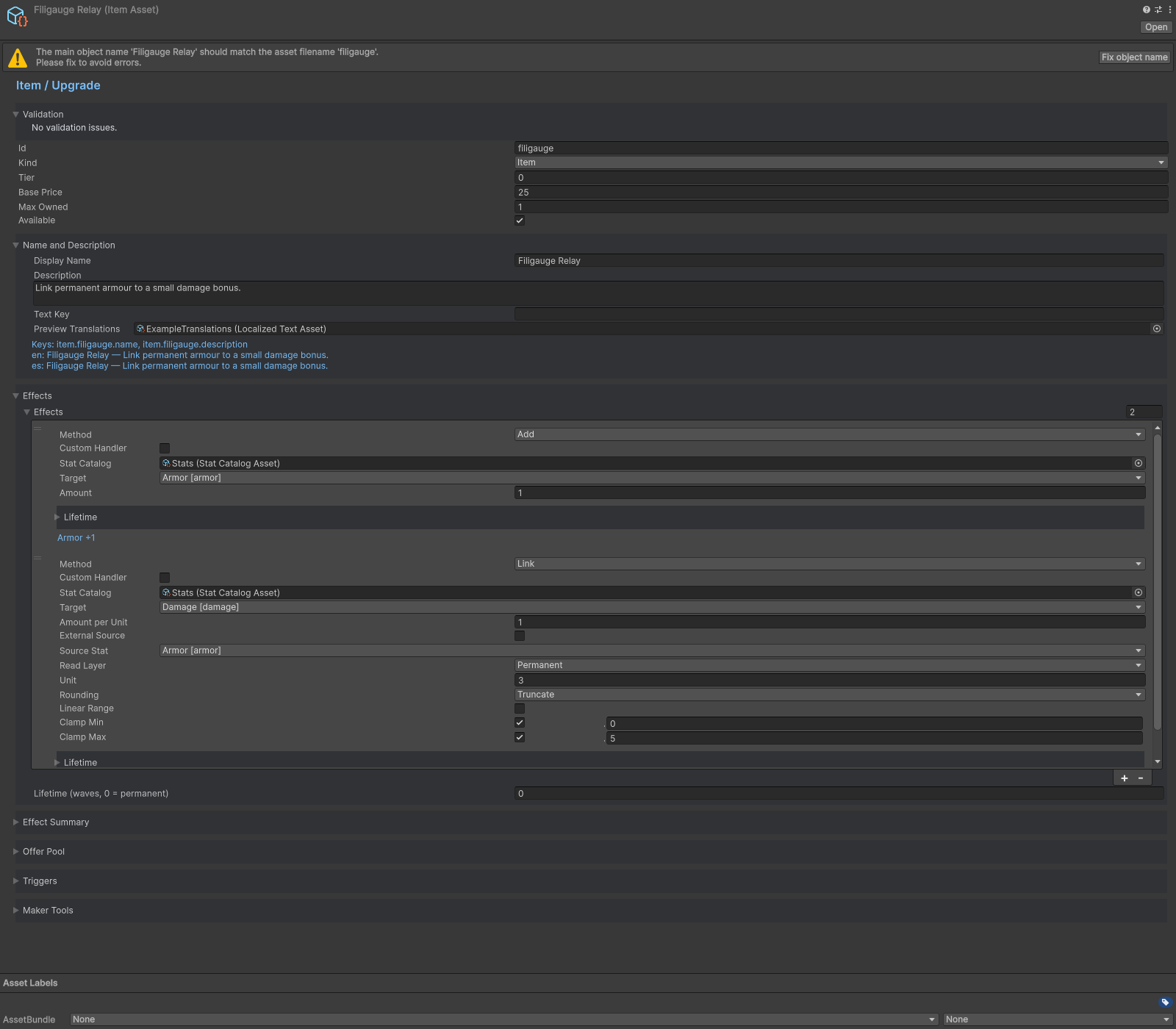
Item inspector with Link effect source and scaling fields.
Check your result
Validate connected content before starting a new measurement or run. Keep the settings, seed and content version with any result you compare. For code-only adapters, compile against the package version you ship and configure the required authored data before gameplay.